


Unpacking My Subtitle

dreamstime_xs_12112875

Having just published my book, Tell Me A Story: Creating Life-Changing Ministries from Stories, the book has demanded a lot of my attention lately.  Some of that attention is focused on the book’s title.   When I think of the title, some of my thoughts are about the people who helped me get what I think is a good one, but most of them are on what I meant to convey by the title.

The title, Tell Me A Story, was suggested by my friend, encourager, and mentor, Dr. Mathew John.  To be forthright, the title was chosen to draw attention to the book.  However, it also is relevant in the sense that the core idea of the book is that stories are a good way to begin ministry development or improvement.  And it may be that, in one form or another, it is the only way to begin designing anything.  We’ll get to this in a future blog post.

The subtitle, Creating Life-Changing Ministries from Stories, is the combined effort of my long-time friend, encourager, and mentor, Jim Rhodes.  It packs within it several of the key ideas and motivations of the book.  The idea here was to give people some idea of what they will encounter as they read.  Each of the subtitle’s words adds insights to the topics the book discusses in one way or another.

My goal in the next five blog posts is to explore the thoughts behind each of the subtitle’s five words.

You might ask, why are you talking so much about your book when what you really want this blog to accomplish is to create a forum for people interested in ministry design?  Why are you so blatantly promoting your book?  My answer is, first, that I believe the book is a good starting point for discussions of ministry design methods.  But perhaps more importantly, second, I believe each of the words in my subtitle suggest topics that are fundamental to the whole idea of ministry design.  So with this series of blogs, I feel I am laying groundwork for what all of us in the community will be discussing.

So, stay tuned as we unpack the subtitle.  If you want to know when each new blog post appears, follow me on my Twitter account, which you can reach from the little Twitter logo at the bottom of this page.

And please comment on my posts to turn a monologue into a dialogue.
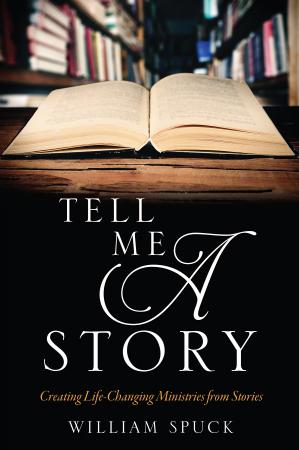
The Book Is Now Available

Book Cover

My book, Tell Me A Story: Creating Life-Changing Ministries from Stories, is in print and has hit the bookstores!  (Can you tell I’m excited?)

You may order a copy from any of the following sources:

As I’ve mentioned in previous blog posts, this book describes a simple, step by step way to create or improve ministries.  The book is aimed at pastors, lay leaders, and parachurch professionals who are responsible for developing or improving their ministries.

Typically, ministries are created or improved either by adapting existing ministries or by putting together ideas generated by brainstorming sessions.  This works adequately for simple ministries, but it is not likely to lead to good results when needed ministries become more complex.  The Story Method of my book provides a step by step path to the development or improvement of ministries of any complexity.

The approach of the book begins with simple stories, stories that are written and improved by members of design team.  Once the stories are in good shape, the process amounts two things.  The first is to turn the stories into a design for the ministry.  The second is to lay out a plan for converting the design into a functioning ministry.  The steps in both cases amount to answering a few really simple questions and putting the answers into picture form.  Then, of course, the plan needs to be implemented, and the ministry can begin.  That’s it.

Read the book and continue to follow me on this blog.  When you are ready to ask questions or make comments, my contact information is at the end of the book.

Writing Across the Cerebral Divide

dreamstimeextrasmall_66976110The idea of crossing the continental divide implies entering new territory, encountering new experiences, expanding horizons.  Many people would shy away from crossing this divide because of these implications.

When it comes to communicating technical ideas to some people, there is a similar divide, one we might call the cerebral divide.  Many people shy away from crossing this divide because either they fear they will not fathom what they experience or, worse, because they don’t want to put in the effort it takes.

This cerebral divide is what I faced as I started to write Tell Me A Story: Creating Life-Changing Ministries from Stories.  As is apparent, I am an engineer, a technologist, some would say a geek.  The audience I wanted to reach as I wrote was pastors, lay leaders, and leaders of parachurch ministries.  Many of these people avoided what is now called STEM (science, technology, engineering, and mathematics) for as long as they can remember.  My challenge was to translate technical ideas from my world to theirs.  The fact that most of these ideas appear all over the business as well as the STEM world doesn’t matter.  Eyes glaze over, distractions distract, the fly on the window is more interesting.

To make matters worse, I asked a couple of pastor friends to read the first draft of my book.  To be specific, I asked them to be honest and constructively critical.  In short, they were: they did not like the book.  It was too technical – not so much in content but rather in terminology.  And my attempts to explain the terms compounded the problem.  Even though I had already figured out that I could solve the most complicated part of my message by asking my readers to write simple stories, it was not enough.

Then I asked my friend Tom Ferguson, who is a builder, to read the book.  He got the content but agreed that my writing style was the problem.  I was just too used to writing for business and technical audiences.  Fortunately, he also gave me the solution.  He had read early drafts of another book on design methods I was writing.  I had decided after a couple of tries at other styles to write that book as a novel.  So, Tom said (and I am paraphrasing), “Bill, if you’re talking about using stories to design ministries, why don’t you do what you did for the other book?  Use a story to tell people how to design ministries.  Let your characters struggle with the ideas; let their questions reflect what you think your audience’s questions will be, and let your story answer them.”  So, I rewrote the book.

Fortunately, the next time around, as people from my intended audience read the manuscript, they liked it – or at least they thought it explained the Story Method understandably.  I won’t say that a story is always the way to cross the cerebral divide, but it is at least one way.  It turns out that stories are one thing with whom people on both sides of the divide resonate.


My Book Is Coming Soon

I am writing it to let you know that I am putting the final touches on a new book, Tell Me A Story: Creating Life-Changing Ministries from Stories.  It will soon be available from Amazon and from my publisher, Xulon Press.

The book observes that some ministries can (or should) be too complex to emerge from the ad-hoc processes usually followed by churches and para-church organizations.  My experience is that ministries become less and less effective the larger and more complex they are.  The reason for this is simple: they weren’t designed; they were assembled.

Most ministries are created either by adapting a ministry the organization has used or seen before (and this is not a bad method for simple ministries), or by putting together the products of brainstorming.

By brainstorming I mean the familiar process of assembling a group, asking for ideas from everyone, and, later, selecting the best ideas to be combined into the ministry.  Brainstorming has two big drawbacks.  First, it is somewhat hit or miss; it just collects ideas, and there is no objective way to know if there are enough ideas or if they span the needs of the ministry.  Second, brainstorming creates no information on the relationships between the ideas.  Ministries are not just a collection of ideas or as I prefer to call them, ministry components; they need to be structured so that those to whom the ministry is aimed can move easily from one ministry component to another.

Tell Me A Story suggests a more powerful method for designing or redesigning the more complex ministries.  I call it the Story Method because it begins with stories written by several people and simply but systematically draws a structured ministry design from this collection of stories.  The Story Method is based in proven design methods from the business and technical world, but one way to view the book is that it translates these proven methods into everyday language.

In any event, I’ll tell you more as we go along and get closer yet to the publication date, but I wanted you at least to know what to anticipate.

Welcome to my Blog

This is my first blog post.  Well, actually, it’s my second or third try at a first blog post.  I’ve posted an attempt or two before, but decided they weren’t really what a first blog post should be.  I’m new at this, you see.

Why am I beginning to blog?  An honest answer goes something like this:  I’ve written a book, and I’m about to publish it.  The publisher, Xulon Press, urged me to build a platform based on the book Platform by Michael Hyatt.  Mr. Hyatt urges authors to blog as an important element of their platform.

So, what’s my book, and what’s it all about?  My book’s title is Tell Me a Story: Creating Life-Changing Ministries from Stories.  It tells about a method to develop new ministries when they are going to be too large or complex to simply think them through or adapt a ministry people have done may times before.  Further, since all design is really redesign (a claim I explain in the book), it applies not only to creating new ministries, but also to improving existing ones.

Tell Me a Story is aimed at pastors, lay leaders, and leaders of para-church ministries.  I’m an engineer and engineering manager.  And, because you who do this, are not generally inclined to my world, I needed to find a way to translate my world into your language.  After a couple of tries, I was encouraged by some friends to write the book itself as a story, so that’s what it is, hopefully, nice and friendly.

So, that leads me to my last and final question for this blog, and that is, if I’ve written Tell Me a Story and want to talk about it, then, why do I title my blog “Ministry Design?”   Here my answer is that I’m was motivated to write the book out of a desire to help people (specifically, my church) design and improve better ministries.   I’d like this blog to gather a community of people who share my desire to design and improve ministries.

Blogs are all about dialog between a host and his or her readers.  I’d like to focus my blog’s dialog around ministry design.  Of course, I’ll blog about the book, but I’ll blog more about the bigger topic, and I’ll eagerly enter discussions with you, my readers, about either.  So, if you already have thoughts you’d like to share, let us all (me and the other readers) hear them.  If you’re not ready to dialog yet, come back and see if what I say in a future blog post stimulates a conversation that can help us all.